
You probably know the number we’re meant to hit each night. Whilst the NHS recommends seven to nine hours of sleep a night for adults, in between work, going to the gym, seeing loved ones, kids routines, making dinner, and other daily non-negotiables, it can sometimes feel like an impossible task to fit it all in.
The average Brit sleeps just 6.4 hours a night, even though we spend more than seven hours in bed, and only 5% of us always wake up feeling refreshed. Falling half an hour or so short doesn’t sound like much, but over a week it’s more than four hours. Over a year, it’s over 200 hours: roughly nine full days of sleep, lost.
The clocks go back on Sunday 25th October. The long, dark, screen-lit evenings are about to start, so it’s a good moment to look at what that missing sleep is costing us, and what actually helps.
What does sleep debt cost?
Sleep debt is the difference between the sleep your body needs and the sleep it actually gets. And unlike other debts, it’s surprisingly easy to lose track of.
Studies have shown that when people sleep six hours a night for a couple of weeks, their focus and reaction times slip to roughly where they’d be after a night or two of no sleep at all. Yet most of them say they feel fine, and running short starts to feel normal.
It isn’t only us who pay for it, either. Lack of sleep is estimated to cost the UK economy up to £40 billion a year, the equivalent of around 200,000 lost working days. Some of that is sick days, but most of it is people who make it to their desks but are slower, foggier and more prone to mistakes than they’d be after a proper night’s rest.
And we feel it. Most of us would love a solid eight hours, but only around a quarter of us actually get them, and more than half of us rarely or never wake up feeling properly rested.
In comes sleep apps and melatonin gummies
Faced with all this, the natural instinct is to buy a fix: a supplement, a sleep-tracking app, a smart ring. Nearly one in five of us now take something to help us sleep.
The trouble is that most of these tools deal with the symptoms instead of the root cause. Your body clock is set by a handful of signals: light, darkness, temperature, and routine. A tracker can tell you that you slept badly, but it can’t make your evenings any darker or make up for a morning spent under strip lighting.
Screens, of course, make it even harder. Reading on a tablet before bed can push your body clock back by more than an hour, so you fall asleep later and wake up groggier than you would with a paperback. It’s hard to fix a problem with an app when the device it lives on is part of the problem.

The environment reset: what the research says
In 2013, Professor Kenneth Wright sent volunteers camping for a week, with no artificial light after dark. They got around four times more daylight than usual and by the end of the week their melatonin (the hormone that tells your body it’s time to sleep) was rising almost two hours earlier, in time with sunset.
The follow up study, published in 2017, found it didn’t need a whole week. A single weekend outdoors shifted melatonin timing 1.4 hours earlier. A winter version, run around the solstice, found campers got 13 times more natural light than on a typical Winter day, and their melatonin rose 2.6 hours earlier.
The takeaway isn’t that you need a tent, but that your body clock responds quickly once it gets clear signals. Plenty of daylight during the day, real darkness at night, and fewer screens in between.
And another useful element: a 2019 review of studies on bathing and sleep found that a warm bath, taken one to two hours before bed, helps people fall asleep faster. Warm water draws blood towards the skin, and as the body cools afterwards, it takes that drop in core temperature as a cue that it’s time to sleep.
What that looks like at The Wild Root
The Wild Root is three cabins in the Buckinghamshire Chilterns, about an hour from London. Hidden within a beautifully curated escape, we happen to have the ingredients the research points towards to reset your sleep.
Daylight.
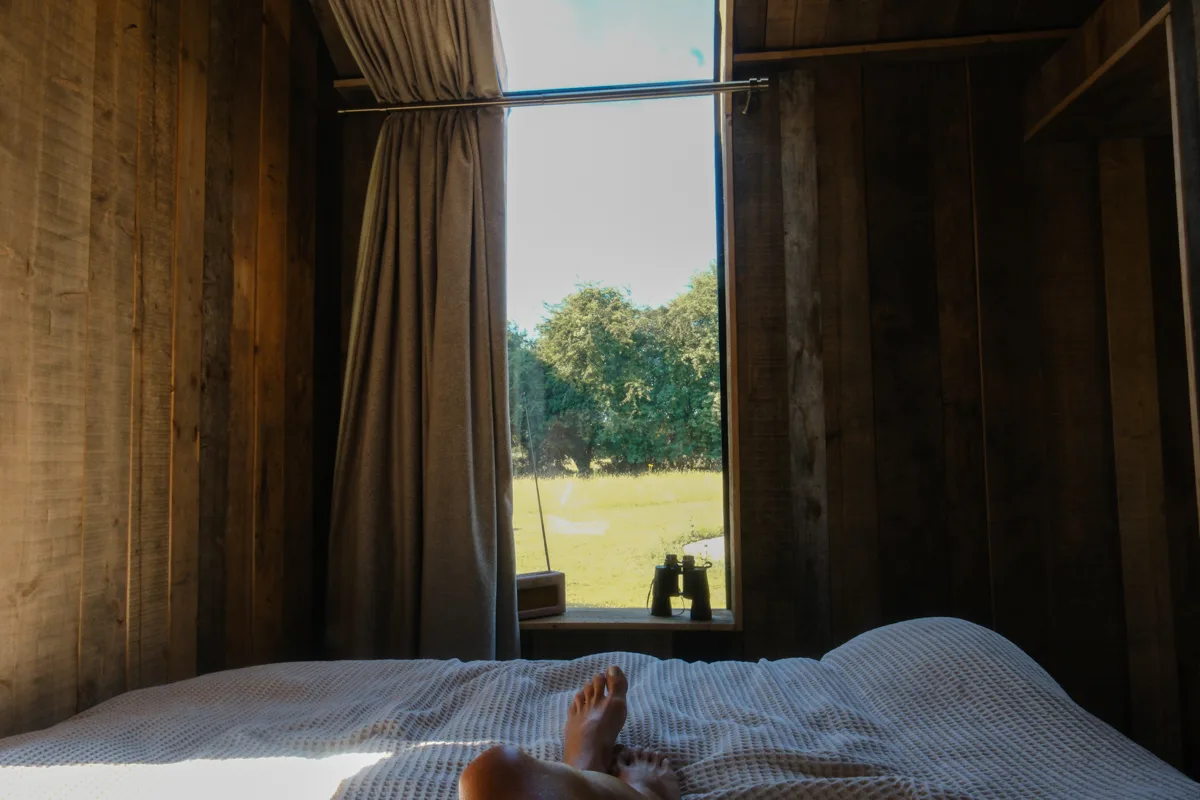
Mornings start with natural light across the fields and woodland, with attention very much diverted away from a phone screen.
Darkness.
Out here, nights are properly dark. The sky is much clearer than in the city, and evenings are lit by fire pits and low lamps rather than overhead lights.
Warmth.
Each cabin has its own outdoor bath – copper at Dusk, brass at Ember, tin at Rise – perfect for any time of the day, including 1-2 hours before bed if you’re hoping for a deeper, more restful sleep. The Haze sauna, handcrafted by Full Circle Saunas, is an equally good way to warm up and cool down.
Routine.
No commute, no inbox, nowhere to be. A couple of days of going to bed when it’s dark and waking when it’s light is all it takes to reset your body clock and your nervous system.
Five small changes to try at home
You don’t need to leave home to start sending your body better signals.
1. Get outside within an hour of waking.Even on a grey October morning, outdoor light is far brighter than anything indoors. The clocks going back means lighter mornings for a while, so make the most of them.
2. Dim the house after dark. Swap overhead lights for lamps for the last couple of hours of the evening.
3. Take a warm bath or shower one to two hours before bed.Not right before. Leave time for your body to cool down.
4. Keep your phone out of the bedroom. It will make a huge difference.
5. Keep your wake up time consistent, weekends included.A regular morning anchors your body clock more reliably than a regular bedtime.
A reset, not a cure
A couple of nights away won’t undo a year of short sleep. But what a stay can do is remind your body what the right signals feel like.
Autumn and winter stays are when the dark skies are at their best, and we’ve just released our new seasonal menu “a little more”.